

The Machines
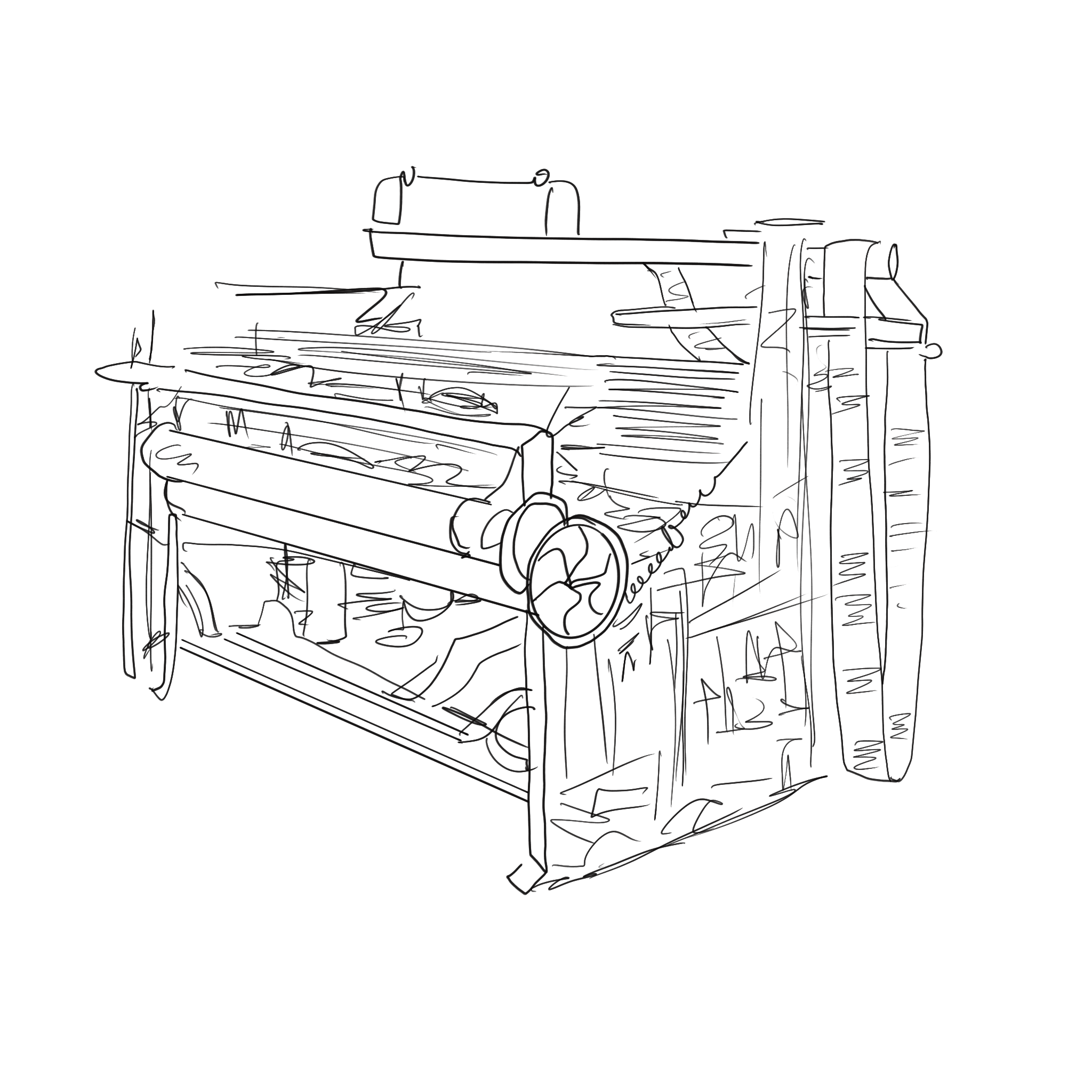
The Machinery
Creels, Warpers and Looms – Oh My!
An overview of the tools and machines used in the production of a Macgee Cloth blanket.
Fully Equipped
The mill came together one piece of equipment at a time. Tracking down machinery long since abandoned for newer technology proved quite the feat, but Pam made it happen. To better understand the role each machine plays in the creation of a blanket we recommend reading this page.

Found In: Yorkshire
The Creel
The cones of thread are arranged on a giant rolling rack called the Creel. The pattern of the warp is determined by the arrangement of the spools. Each thread is then wound to feed through the reed onto the warper.
Pam found her 1960s creel in a warehouse in England.

Found In: Wales
The Reed
As the threads come off the creel they are positioned through the reed in a specific order, which creates the warp pattern of the blanket.
Pam found her reed, date unknown but likely early 20th century, in Wales.

Found In: Wales
The Charlesworth Warper
Perhaps the only one of it's kind in use in the world today, this Charlesworth warper was manufactured around 1895.
The warper is a pivotal piece of equipment used to create the warp (the vertical threads of the blanket).
When this warper was sold it hadn't been in use for years and was thought to be possibly broken. But, after being shipped to Canada and reassembled, Pam discovered it worked perfectly.

Cones of yarn on the creel feed through the reed onto the Charlesworth warper

Found In: Yorkshire and Wales
The Looms
The industrial shuttle loom was the first of the industrial loom inventions beginning at the late part of the 19th century. These looms create the same fabric a hand weaver does, only a shuttle loom has a continuous weft thread as it circles the edge until the bobbin runs out and the thread is hand crossed at that point to create a seamless weft. A complete cross of the shuttle (shich houses the bobbin) is called a pick.
Though automated with 400 volts of power, the loom uses only the amount of electricity of a hand drill, as the 'picking balls' have centrifugal balance which conserves their kinetic energy.
Pam found three Dobcross Shuttle Looms, one, circa 1936, was found in a leaky container in a sheep pasture in Wales. The other two looms were sourced from a dealer in Yorkshire.
Wait! There's more
Other, not pictured, machinery includes Pirn winders to wind the wooden bobbins,
and a Whitely cone splitter from 1905.

A close up of threads woven on the loom
Continue Reading
There's More to Learn

Her Story
A trip to Spain prompted a mission in doing the impossible: tracking down machines from a century ago and restoring them to their former glory.
Follow the Adventure
The Fibres
Who can say exactly where the threads in their blankets came from? Pam can. Each and every fibre woven into a Macgee blanket has true provenance.
Discover the Origin
Make a Blanket
There's a lot more to crafting a Macgee blanket than weaving alone. From fabric and colour selection to warping and weaving to finishing each piece by hand.
Follow Step by Step
Vertical threads on the warper